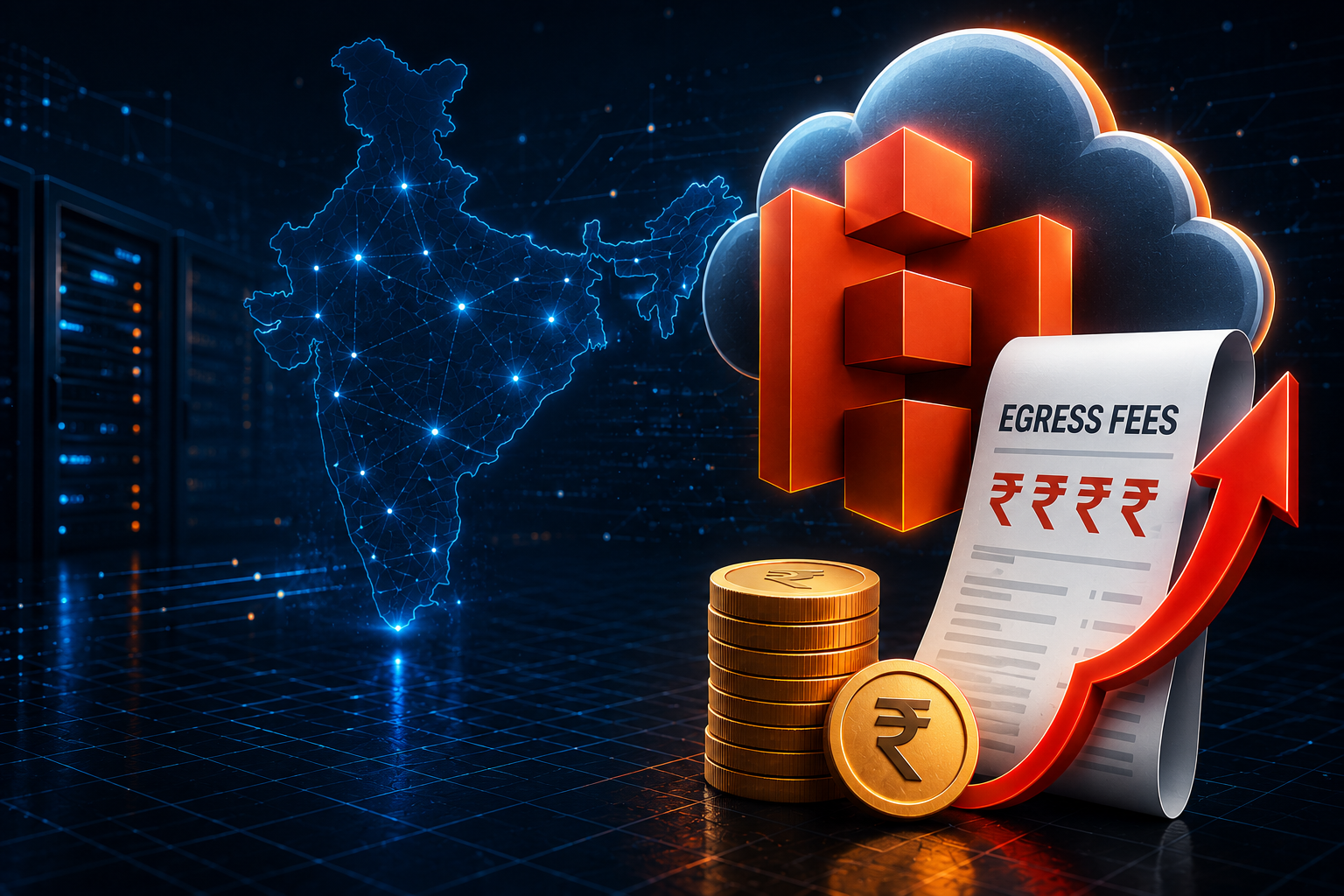
If you're running workloads on any Hyperscaler S3 in India and your bill keeps climbing without a clear explanation, egress fees are almost certainly the culprit. Cloud storage looks deceptively cheap at the entry level until data starts moving.
For IT managers and CTOs operating in the Indian market, understanding exactly where these charges originate is essential for controlling infrastructure spending.
What Are Egress Fees and Why Do They Exist?
Egress fees are charges applied when data leaves a cloud provider's network, among the most misunderstood line items in any infrastructure budget. They aren't a bug in the pricing model. They're a deliberate design, and hyperscalers built them in from the beginning.
The basic idea is that inbound data (ingress) is free, but outbound data costs money. Hyperscalers frame this as a cost recovery mechanism for network transit, but the practical effect is a financial lock-in. Once your data lives in S3, moving it to your users, your on-premises systems, another region, or another provider triggers a fee every single time.
This is not speculation. It's how cloud hyperscalers have operated for over a decade, and India-based enterprises are particularly exposed given the combination of high data volumes, distributed user bases, and relatively underserved local infrastructure alternatives.
How Hyperscalers’ S3 Egress Pricing Works in the India Region
The hyperscaler Mumbai region (ap-south-1) carries its own pricing tier, and it is not cheap. Data transfer is one of those line items that quietly becomes a bigger deal than people expect. While these costs may seem manageable at smaller scales, they increase quickly as data volumes grow.
For example, organizations transferring tens of terabytes of data each month, such as media platforms, SaaS companies, or analytics providers, can see data transfer end up eating a real chunk of the monthly bill, separate entirely from what they're already paying for compute, storage, API calls, and replication. This is important to account for while planning cloud infrastructure and budgets.
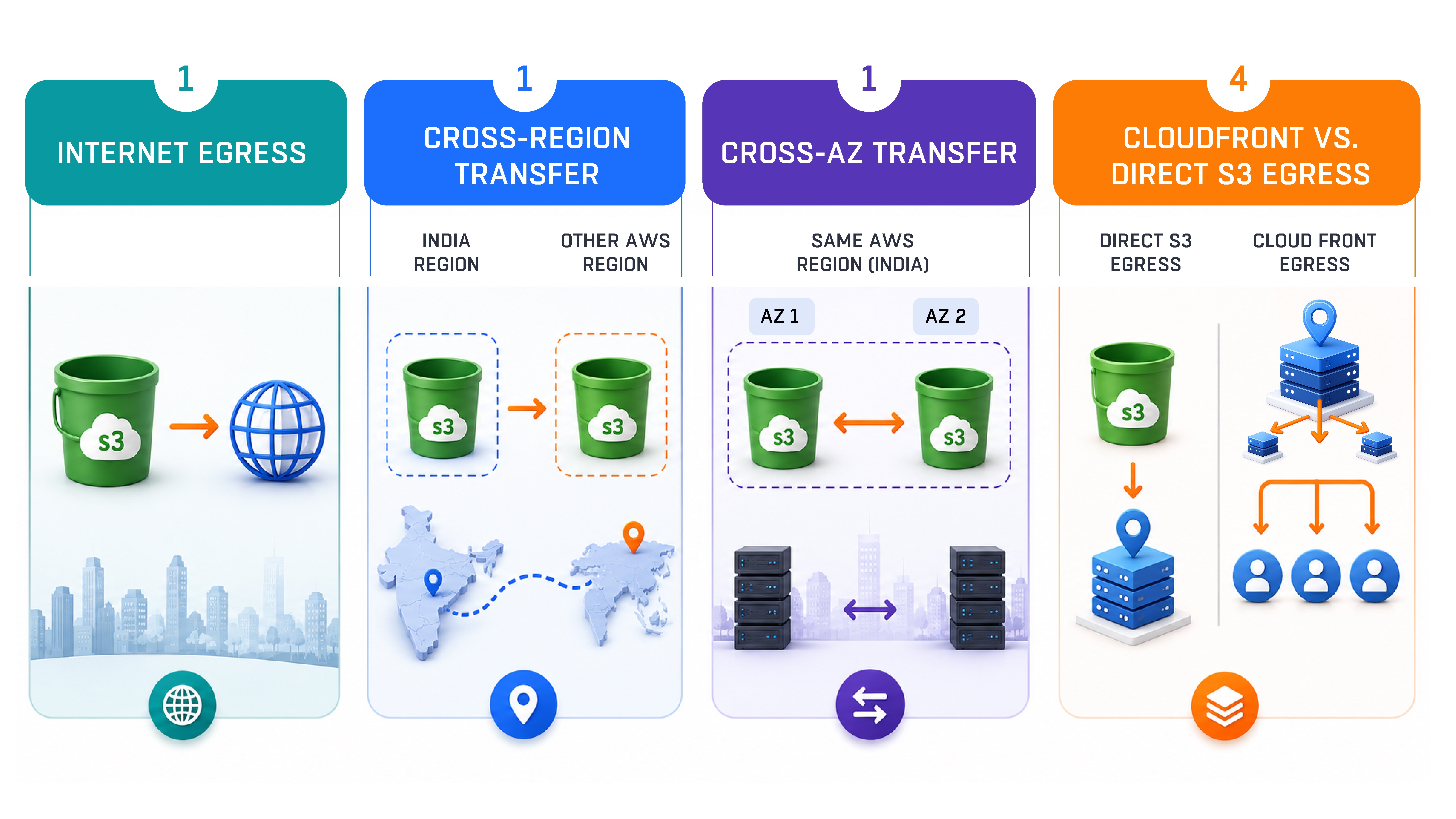
There are several fee categories worth understanding separately.
- Data Transfer Out to the Internet
- Cross-Region Transfer
- Cross-AZ Transfer
- CloudFront vs. Direct S3 Egress
This is the most common and often the most costly data transfer charge. Any request from an end user, such as downloading a file, streaming content, or receiving an API response, counts as egress if the data leaves hyperscaler's network boundary.
If your architecture pulls data from the Mumbai region to another hyperscaler region such as Singapore or US East cross Region data transfer charges apply. While these charges may appear small on a per transfer basis, they can accumulate quickly in high volume workloads.
Even moving data between Availability Zones within Mumbai can incur data transfer charges. Cross-AZ transfer is easy to overlook in architecture reviews. Most teams notice it when the cloud bill comes in higher than expected and someone starts digging into why.
Using a hyperscaler CDN like CloudFront in front of S3 does reduce direct S3 egress costs. Hyperscaler charges lower rates for CloudFront origin fetches. But CloudFront adds its own transfer and request pricing, and for India-focused deployments with regional audiences, it doesn't always deliver the savings the documentation implies.
The Real-World Scenarios Where Costs Spiral
Three patterns drive the worst egress surprises for Indian enterprises.
The first is backup and disaster recovery replication. Organizations that replicate S3 data to a secondary region for compliance or resilience are paying cross-region transfer fees continuously, on every object version, every replication cycle. The second is application logging and analytics. When applications write logs to S3 and a separate analytics pipeline reads them out for processing in Redshift, a third-party SIEM, or a self-hosted tool, that outbound read traffic is billed as egress. Teams rarely size this correctly at the architecture stage. The third pattern is multi-cloud egress, which is the costliest of all. Pulling data from S3 to a workload hosted on Google Cloud, Azure, or a private data center carries the full internet egress rate. There is no partner pricing, no reciprocal arrangement, no discount. You pay full rate, every gigabyte, every time.
The second is application logging and analytics. When applications write logs to S3 and a separate analytics pipeline reads them out for processing in Redshift, a third-party SIEM, or a self-hosted tool, that outbound read traffic is billed as egress. Teams rarely size this correctly at the architecture stage.
The third pattern is multi-cloud egress, which is the costliest of all. Pulling data from S3 to a workload hosted on Google Cloud, Azure, or a private data center carries the full internet egress rate. There is no partner pricing, no reciprocal arrangement, no discount. You pay full rate, every gigabyte, every time.
When Hyperscaler S3 Still Makes Sense and When It Doesn't
Hyperscaler S3 remains the right choice for many use cases. If your workloads are entirely contained within the hyperscaler ecosystem, such as Lambda, EC2, ECS, and RDS, and your data rarely leaves the hyperscaler network to the internet or other cloud providers, data transfer costs are generally easier to manage. In addition, data transfers between supported hyperscaler services within the same Region are typically not subject to egress charges.
But the moment your architecture involves external consumers, multi-cloud pipelines, on-premises integration, or large-scale data distribution to end users across India, S3's egress model works against you. The cost-efficient cloud storage decision in that context is not to optimize within S3, it's to reconsider where the data lives.
Complicate that picture further: even teams that migrate storage away from S3 sometimes face egress charges during the migration itself. Moving several hundred terabytes out to a new provider can generate a one-time bill that takes months to recover from in savings. Egress pricing doesn't exempt exit.
How Stornox Approaches Cost-Efficient Cloud Storage
At Stornox, we think cloud storage shouldn't be this complicated. That's why we've built an S3 compatible object storage platform that helps Indian enterprises manage, access, and move data without the burden of unpredictable data transfer costs.
Whether you're handling backups, media delivery, or data-heavy workloads, Stornox gives you scalable, enterprise-grade storage that migrates over from hyperscaler S3 without much hassle. If you're looking to optimize cloud storage costs without compromising on performance or reliability, our team is ready to help you find the right solution for your infrastructure..
Frequently Asked Questions
Ready to Reduce Your Cloud Storage Costs?
Discover how Stornox helps enterprises simplify storage, improve performance, and avoid unpredictable egress costs.